
As an Amazon Associate, we earn from qualifying purchases. This post contains affiliate links – if you buy through them, we may earn a commission at no extra cost to you.
Finding your way in the dark can be difficult, especially in a home with hallways or stairs. A good amber night light with a motion sensor helps you move safely without triggering harsh overhead lights. These devices use warm-toned light to illuminate paths only when you’re nearby, supporting natural sleep rhythms by reducing blue light exposure.
When choosing, check the power source first. Plug-in models save you from replacing batteries, but they require an outlet. Battery-operated versions offer more placement freedom, allowing you to stick them inside closets or on non-metallic surfaces. If you choose a plug-in unit, look for a compact design that leaves the second outlet free for other devices.
Sensor range is equally critical. Some models detect movement up to 23 feet away, while others require you to be within 10 feet. If you’re placing a light in a long hallway, prioritize a wider sensing angle—up to 360 degrees—to ensure the light activates before you reach the dark zone.
Brightness needs vary by room. Use a dimmable model to set a soft 1-lumen glow for bedrooms or a brighter 150-lumen beam for stairs. Many lights feature a memory function that saves your last setting, so you never have to readjust them. If you find the light stays on too long, select a model with a 15 or 20-second shut-off timer to save energy.
This guide covers ten options based on manufacturer specifications, including sensor range, brightness control, and power type. We didn’t test these items ourselves. Our choices rely on provided data to help you compare what is available. This guide is for education only and isn’t medical advice.
Quick Picks
QUICK ANSWER · OUR TOP PICKS AT A GLANCE
Best overall: Amber Motion Sensor Nightlight. This model provides 1-150 lumens of brightness and features an advanced PIR sensor. It’s ideal for those who want a consistent, dimmable light that stays in standby during the day to save energy.
Most versatile: Rotatable Amber Nightlight. The 300-degree bidirectional horizontal rotation allows you to switch between front lighting and backlighting. With a 16-foot, 130-degree sensing range, it’s the superior choice for hallways and bathrooms where you need to direct light precisely.
Best rechargeable: Dimmable Amber Rechargeable Light. If you lack an open wall outlet, this unit uses magnets or adhesive metal patches to attach to any surface. It offers up to 20 lumens and eliminates the need for batteries, making it perfect for closets or stairways.
Widest detection: 360 Degree Motion Nightlight. This model boasts a 23-foot sensing range and a 360-degree field of view. Its dual-source design illuminates both the path ahead and the floor directly beneath your feet.
Best eye-care focus: Swanwick Anti-Blue Night Light. This light is specifically engineered to emit amber tones that minimize blue light exposure. It’s the best choice for bedrooms and nurseries where you want to maintain natural sleep-wake rhythms.
Compact design: MAZ-TEK Motion Sensor Light. Operating at a maximum of 0.5 watts, this light is designed for energy efficiency. Use this if you need to light high-traffic areas like garages or basements. Always check your outlet orientation; compact designs are intended to leave the second socket free for other devices.
Comparison Table
How We Picked
To select these products, we analyzed manufacturer specifications for sensor sensitivity, light intensity, and installation requirements. We prioritized transparency regarding how the lights operate, specifically focusing on documented sensor range, motion-detection angles, and power consumption metrics.
These listings were compared based on their power source specifications to suit different home layouts. If you have an available wall outlet in a hallway or stairwell, choose a plug-in model to avoid the maintenance of replacing batteries. If you need to illuminate a closet, cabinet, or area without an outlet, look for the battery-operated or rechargeable versions.
We also compared how these lights handle ambient light. Most models use a dusk-to-dawn sensor to stay off during the day, which maximizes energy efficiency. When comparing brightness, note that some units offer a narrow range of 1–20 lumens, while others provide up to 150 lumens. If you’re sensitive to light or prone to insomnia, prioritize models with amber light technology, which minimizes blue light exposure.
We categorized these lights by their specific utility, such as those with 360-degree detection ranges for large hallways versus those with focused beams for tight corners. Finally, these listings were compared based on their own listed technical features rather than hands-on testing. Commissions don’t influence the ranking of these items, ensuring our selection remains focused on the provided specifications.
Product Reviews
1. Amber Motion Sensor Nightlight

This plug-in light is a strong choice for general use in hallways or bathrooms. It features a motion sensor that works in dark areas and offers three modes, including two auto-off timers. You can dim the light across five levels or use the step-less dimming feature to find the perfect glow. The up-and-down light design helps prevent glare while providing enough light to see clearly.
2. Rotatable Amber Nightlight

This model stands out because it can rotate 300 degrees to provide either front or back lighting. It includes a flat Fresnel lens that improves sensor efficiency by 64% compared to older versions. You can adjust the brightness up to 150 lumens, and it remembers your setting if it stays plugged in. Additionally, the motion sensor’s sensitivity is high, with a range of 16 feet and a 130-degree field of view.
3. Dimmable Amber Rechargeable Light

If you have a spot without an outlet, this rechargeable light is a great solution. It attaches to iron surfaces with magnets or to other walls using included sticky patches. You can dim the light from 1 to 20 lumens to suit your needs. The main drawback is that it requires regular recharging, which may be inconvenient compared to a plug-in model.
4. 360 Degree Motion Nightlight

This cylindrical light provides wide coverage, with a sensor that detects movement from every direction up to 23 feet. It directs light both up and down to illuminate the path clearly. Like other Lyridz models, it features step-less dimming and a memory function for your preferred brightness. Furthermore, the design is slightly larger than some flat models, which might block more of a double outlet. Use the 120-second timer setting if you’re navigating a long path to avoid the light cutting out prematurely.
5. Enbrighten SleepLite Motion Light

This light is designed to be reliable, with an ETL safety certification. It features a soft, amber glow intended to be gentle on the eyes. You can choose between light-sensing or motion-sensing modes, or keep it always on. A drawback is that the brightness range is limited to 20 lumens, which may not be enough for some users. If you need to light a large space, the 20-lumen output will likely leave dark corners, making it better suited for small bathrooms or bedside areas.
6. MAZ-TEK Motion Sensor Light

This light offers very simple brightness control with a slide switch, making it easy to set the perfect level. It provides a warm white glow and consumes very little power. The compact design ensures the second outlet remains free for other devices. The light turns off almost immediately after you stop moving. If you’re a slow walker, you may prefer a model that stays lit for a longer duration.
7. LOHAS Dimmable Amber Light

This light is specifically designed to emit no blue light, which may help maintain a more natural sleep environment. It features a dimmable range of 0 to 100 lumens and three lighting modes. One drawback is that the motion sensor range is limited to 5 meters, which is shorter than some competitors. If you have a large open-concept room, the 5-meter limit will require you to place the light closer to your walking path.
8. Amber Motion Sensor 2-Pack

This model offers three distinct lighting effects, letting you choose between a backlight, front light, or both. It features stepless dimming and a very slim profile that fits well in tight spaces. A drawback is that the 15-lumen maximum is quite low compared to other lights, so it may not be bright enough for large, dark stairs. Also, the buttons can be small and hard to press for those with limited dexterity. If you have an outlet behind a piece of furniture, the 0.66-inch thickness allows it to fit in tight gaps where bulkier lights would be crushed or blocked.
9. Small Amber Night Light

This battery-operated light is perfect for closets or corners where you can’t plug in a device. It uses three AAA batteries and includes adhesive for easy mounting on smooth surfaces. The three-mode design allows for versatile lighting, but you must replace the batteries periodically, which is an ongoing task. Another drawback is that the 15-second auto-off time is fixed and can’t be changed. At medium brightness, a fresh set of batteries can last up to 4 months.
10. Swanwick Anti-Blue Night Light
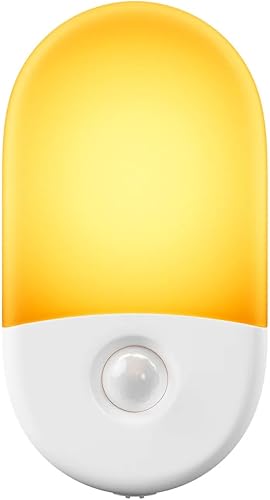
This light focuses on eye care by emitting amber or red tones to reduce blue light exposure. It’s a simple, plug-in device that’s easy to install in any standard outlet. A drawback is that it has fewer customization options for brightness compared to other models in this list. It’s best used in low-traffic areas where you don’t need to adjust the settings once it’s plugged in.
Safety, Care, and Maintenance Tips
Using motion-sensor lights is generally safe, but there are practical considerations for your home environment. Some people may find that certain light frequencies affect their sleep cycle or alertness.
When installing these devices, prioritize models that are ETL safety certified. These units are designed to stay cool to the touch, which is essential for safety in households with children or pets. Always verify that the device is built with flame-retardant materials, such as ABS, to minimize risks.
If you choose a plug-in model, ensure the design is compact enough to leave the second outlet free. This prevents the need for power strips or adapters that can create fire hazards or tripping risks. When using battery-operated versions, replace batteries promptly to avoid leakage or performance failure.
Always follow the manufacturer’s instructions for installation and never exceed the recommended use. If you’re mounting lights on non-metallic surfaces, use the provided adhesive patches or magnetic bases securely to prevent the unit from falling and becoming a hazard.
Be mindful of your specific environment when selecting a light. If you’re sensitive to light or prone to insomnia, look for amber-toned LEDs with a color temperature around 1500K to 1800K. These options effectively block blue light, which can disrupt natural sleep rhythms. If you’re placing lights in high-traffic areas like stairs or hallways, select models with a wider sensing range to ensure the path is illuminated before you reach it.
Related guides
FAQ
Do these lights really help with sleep?
Evidence on how amber light affects sleep is still developing, though it’s widely used to reduce blue light exposure. Results can vary by person, so consider these lights a tool for convenience rather than a health fix.
What should I look for on the label?
Look for the light’s lumen rating to ensure it’s bright enough for your space and check if it has a safety certification like ETL. Also, ensure the sensor range meets the needs of your hallway or stairs.
Do these lights consume a lot of electricity?
Most LED night lights use very little power, often less than one watt. They’re designed to be energy-efficient, especially when using motion-sensing modes that turn the light off when not needed.
Can I use these in a bathroom?
Yes, most plug-in models work well in bathrooms, but ensure the outlet isn’t in a spot where it might be splashed by water. Check the product listing to confirm it’s intended for indoor use.
Conclusion
When choosing an amber night light, think about where you need the most help navigating at night. A plug-in model is usually best for hallways, while battery-operated versions work well in closets or tight corners. Always read the product data carefully to ensure the features match your specific home layout. This article is for education only and isn’t medical advice.