

Acetylcholine & Choline Donors – Optimizing memory and focus. The short answer is that choline supplements may help some people, but they are not reliable “smart pills.” Acetylcholine is central to attention and memory formation, yet adding more choline does not automatically create better concentration. The useful approach is to match the supplement to your goal, start conservatively, and stop if the tradeoff is headaches, sleep disruption, or a wired feeling.

Table Of Contents
• How Acetylcholine Supports Memory And Focus
• Choosing Between Citicoline, Alpha-GPC, And Choline Bitartrate
• A Practical Approach To Choline Donors
How Acetylcholine Supports Memory And Focus
Acetylcholine Is A Signal, Not A Shortcut
Acetylcholine is a neurotransmitter, meaning it helps nerve cells communicate. In the brain, it has an important role in attention, learning, and the encoding of new information. When you are trying to follow a lecture, remember names, or hold a sequence of instructions in mind, cholinergic signaling helps direct mental resources toward relevant information.
The key word is encoding. Memory is not simply a storage bin that can be filled with a supplement. Before a fact, task, or conversation can be remembered later, the brain must first register it well enough to process it. A review of acetylcholine’s role in learning and memory explains that muscarinic and nicotinic receptor signaling is involved in encoding new memories and related memory mechanisms.
That biology explains why acetylcholine is often discussed in nootropics. It does not prove that increasing choline intake improves memory for every person, every task, or every dose.
Consider two people preparing for an exam. One is sleeping six hours per night, skipping meals, and studying while constantly checking notifications. The other is rested and focused but wants a slight edge during a long study block. A choline donor is unlikely to overcome the first person’s basic attention problems. For the second, it might produce a subtle benefit, no noticeable effect, or an unpleasant headache. Baseline brain state still matters.
Choline Is The Raw Material
Choline is an essential nutrient. The body uses it for several jobs, including producing acetylcholine and building phospholipids that are part of cell membranes. Foods such as eggs, meat, fish, dairy, soy, and some legumes provide choline.
The review Choline supplements: An update describes choline as a precursor to acetylcholine and discusses major supplemental forms, including citicoline and alpha-GPC. This is the biochemical rationale for choline donors: they provide choline or choline related compounds that can contribute to acetylcholine synthesis.
Still, precursor supply is only one part of the system. Acetylcholine release, receptor sensitivity, the brain region involved, the mental task, stress level, and sleep status all affect the final outcome. Crossing the blood brain barrier, a common marketing phrase, is also not the same thing as proving better cognition in real life.
Why The Evidence Is Easy To Misread
I would separate the evidence into three buckets before deciding whether a product is worth trying:
• Physiological relevance: Choline is necessary for normal health and participates in acetylcholine related pathways.
• Clinical research: Some studies involve older adults or people with cognitive decline, dementia, stroke recovery, or other medical conditions.
• Healthy adult enhancement: This is the category most supplement shoppers care about, and it has the least consistent evidence.
These categories should not be blended. A compound that is relevant to cognitive decline or medical rehabilitation may not create a noticeable effect in a healthy, well rested 30 year old. In healthy users, any benefit is more likely to be modest, task specific, and variable than dramatic.
Choosing Between Citicoline, Alpha-GPC, And Choline Bitartrate
The Most Useful Comparison Is By Goal
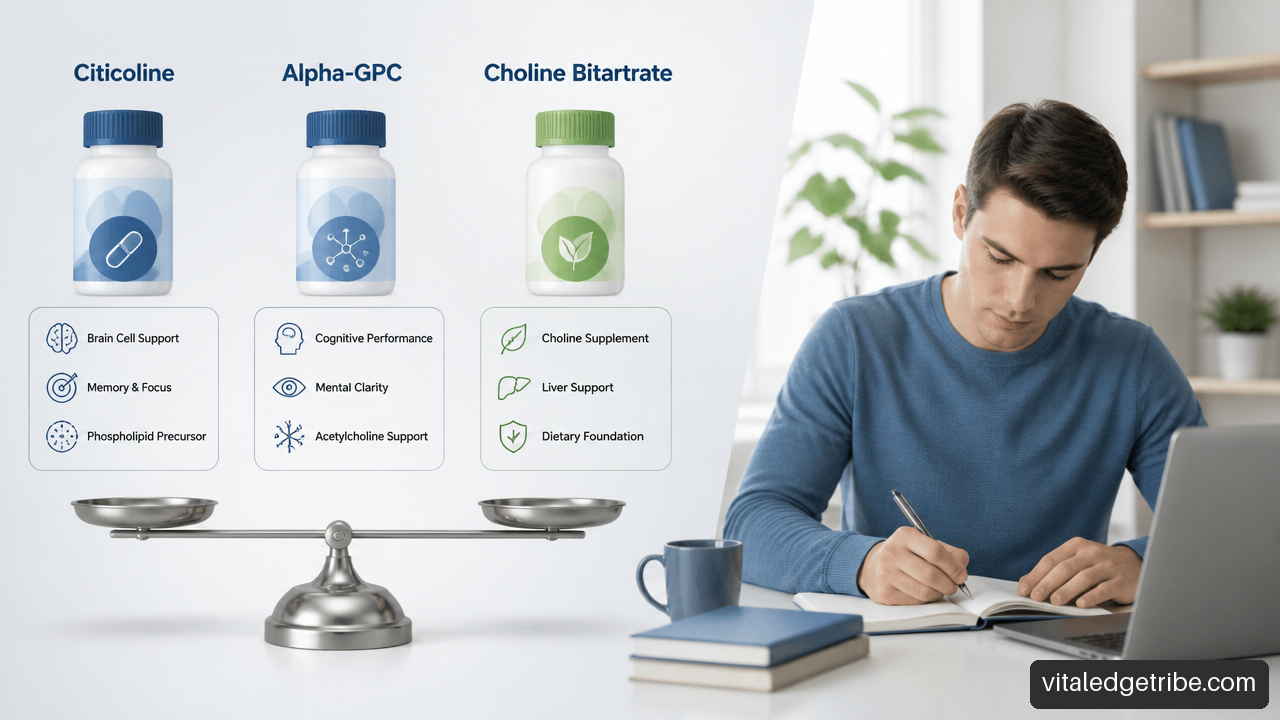
Citicoline, alpha-GPC, and choline bitartrate all relate to choline, but they should not be treated as interchangeable. Their marketing often overlaps, while the evidence and practical use cases do not line up neatly.
| Supplement | What It Is Commonly Used For | Evidence Context | Practical Consideration |
|---|---|---|---|
| Citicoline | Steadier cognitive support and phospholipid related brain metabolism support | Studied in several clinical and cognitive contexts, but healthy adult effects remain variable | Often a reasonable first option for cautious trials |
| Alpha-GPC | More immediate feeling of focus or mental drive for some users | Research and anecdotal claims do not establish uniform benefit in healthy adults | May feel stronger, which can also mean more side effects |
| Choline Bitartrate | Low cost, basic choline supplementation | Acute cognitive results in healthy adults are not convincing | Better viewed as a nutrient source than a proven focus tool |
Citicoline: A Broader Support Profile
Citicoline is also called CDP choline. It is often framed as more than an acetylcholine precursor because it is involved in pathways connected to phosphatidylcholine, a major membrane phospholipid. That has led to interest in its role in brain metabolism and neuronal membrane support.
This is an important distinction: membrane support claims and immediate focus claims are not the same claim. A person may choose citicoline because they want a lower intensity, longer term experiment, not because it is guaranteed to make a work session feel more stimulating.
For general use, citicoline is often the more conservative choice when someone wants to test whether choline support helps without chasing a strong acute sensation. I would avoid interpreting a lack of immediate “kick” as proof that it is ineffective, but I would also avoid assuming subtle mechanisms guarantee a real world memory benefit.
Alpha-GPC: Potentially More Noticeable, Not Necessarily Better
Alpha-GPC provides choline in a form often promoted for memory, attention, and exercise performance. Some people describe it as more noticeable than citicoline. That may make it attractive before a demanding presentation, exam, or deep work block.
The tradeoff is straightforward: a stronger subjective effect is not automatically a better cognitive effect. It can also mean headache, tension, irritability, nausea, or feeling mentally overactivated. If your goal is calm, sustained reading, alpha-GPC may be too intense for some people. If your goal is a short, demanding task and you tolerate it well, it may be the form you choose to test cautiously.
There is no strong basis for declaring one universal winner. Choose based on the task, your sensitivity, and whether you want a steady trial or an occasional acute experiment.
Choline Bitartrate: Cheap Does Not Mean Equivalent
Choline bitartrate is widely available and often inexpensive. It is easy to assume it should work as well as more expensive forms because it supplies choline. The available acute cognition evidence does not support that assumption.
In a study of healthy young adults, acute choline bitartrate supplementation did not improve several memory measures, including spatial, declarative, and verbal memory tasks. That does not make choline bitartrate useless as a nutrient source. It does mean it should not be marketed as an evidence based shortcut to better memory in healthy adults.
For someone deciding between products, this finding creates a practical rule: do not choose choline bitartrate solely because its label promises memory support. A lower price is useful only if the product matches your actual goal.
A Practical Approach To Choline Donors
Start With The Problem You Are Actually Trying To Solve
Before buying a choline donor, define the situation. “Brain fog” can describe poor sleep, stress, dehydration, low calorie intake, medication effects, depression, anxiety, illness, or a demanding schedule. A supplement cannot diagnose the cause.
Use this decision framework:
- Check the basics first. If sleep, food intake, hydration, or caffeine use is unstable, address those for one to two weeks before adding a nootropic.
- Choose one outcome. Examples include remembering material during study sessions, sustaining attention during afternoon work, or reducing mental fatigue during a specific task.
- Choose one supplement. Do not begin citicoline, alpha-GPC, caffeine, and several other nootropics at once.
- Track a simple signal. Note focus quality, headache, mood, sleep, and whether you completed the intended task.
- Stop if the tradeoff is poor. A supplement that adds alertness but damages sleep can make next day cognition worse.
Dosing And Timing Without Overpromising
Supplement labels commonly place citicoline and alpha-GPC servings in the range of a few hundred milligrams. However, there is no universally established “best” dose for healthy adults seeking focus. More is not necessarily better.
A cautious trial usually means choosing the lowest practical labeled serving and taking it earlier in the day. Morning or early afternoon timing makes it easier to see whether the product affects sleep. If a person is highly sensitive to caffeine or tends toward anxiety, starting with less than a full serving may be sensible after discussing individual circumstances with a clinician or pharmacist.
Avoid using a choline donor as a daily automatic habit from day one. A better test is to use it consistently for a limited period, such as several planned work or study sessions, while keeping sleep and caffeine relatively stable. If there is no clear benefit after a reasonable trial, increasing the dose repeatedly is rarely the best answer.
Stacking With Caffeine Or L Theanine
Caffeine can improve alertness, but it can also raise anxiety and interfere with sleep. L theanine is often paired with caffeine because some people find the combination feels smoother. Adding a choline donor makes the stack harder to interpret.
I recommend a sequence rather than a pile of capsules:
- Test the choline donor alone on a low stakes day.
- If it is well tolerated, test it with your usual caffeine amount, not a larger amount.
- Keep the timing and task similar across trials.
- Do not add another compound until you know what the first combination does.
A practical example: if alpha-GPC plus coffee improves urgency but makes you clench your jaw, rush through reading, and sleep poorly, that is not a successful focus stack. It is overstimulation wearing a productivity label.
Stop Rules For “Too Cholinergic” Symptoms
People often use the phrase “too cholinergic” to describe an uncomfortable response to a choline focused stack. It is not a formal diagnosis, but the pattern can still be useful for decision making.
Pause the supplement and reassess if you develop three or more of the following after starting or raising a dose:
• New or worsening headaches
• Nausea, stomach upset, or unusual sweating
• Muscle tension, restlessness, or irritability
• A flat, low mood or mental fatigue that feels worse rather than better
• Trouble falling asleep, vivid dreams, or disrupted sleep
• A clear drop in concentration despite feeling stimulated
Do not try to “push through” repeated symptoms by adding other supplements. Return to your baseline routine. If symptoms are severe, persistent, or occur alongside medication changes, seek medical advice.
People using prescription medications, especially drugs that affect acetylcholine, cognition, mood, blood pressure, or neurological conditions, should speak with a qualified healthcare professional before using choline supplements. Pregnancy, breastfeeding, liver or kidney disease, and a history of significant psychiatric or neurological symptoms also justify individualized guidance.
Key Takeaways
What The Evidence Supports
• Acetylcholine is deeply involved in attention, learning, and memory encoding.
• Choline is essential and serves as a precursor for acetylcholine, but more precursor does not guarantee better cognition.
• Citicoline and alpha-GPC are more relevant options for a focused supplement trial than choline bitartrate.
• Choline bitartrate has not shown acute memory benefits in at least one healthy young adult study.
What I Would Do In Practice
• Start with sleep, food, hydration, and caffeine habits before treating brain fog as a supplement problem.
• Choose citicoline for a more measured trial or alpha-GPC for a cautious, task specific test if you tolerate stimulating compounds well.
• Use one new variable at a time and track both benefits and costs.
• Stop rather than escalate if headaches, sleep disruption, nausea, or agitation appear.
The best outcome is not feeling “more stimulated.” It is completing the task with better attention while preserving mood, sleep, and next day function.
Frequently Asked Questions
Does Acetylcholine Actually Improve Memory And Focus?
Acetylcholine signaling supports attention and memory encoding, but increasing choline intake does not reliably improve memory or focus in everyone. The best supported statement is that acetylcholine is necessary for normal cognitive processes. Supplement benefits in healthy adults are less certain and tend to be modest when they occur.
What Is A Choline Donor, And How Is It Different From Acetylcholine?
Acetylcholine is the neurotransmitter itself. A choline donor is a nutrient or compound that supplies choline related material the body can use in pathways involved in acetylcholine production. Taking a donor does not mean acetylcholine rises in a simple, predictable way throughout the brain.
Is Citicoline Better Than Alpha-GPC For Focus?
Neither is universally better. Citicoline may be the better fit for someone seeking a steady, lower intensity trial with an interest in phospholipid related support. Alpha-GPC may be the better fit for someone testing short term focus support, provided they are not prone to headaches, anxiety, or sleep disruption. Healthy adult head to head evidence is limited.
Which Choline Supplement Is Best For Studying?
For a cautious study experiment, citicoline is often the more measured starting point. Alpha-GPC may be worth testing for a short, demanding session if you have already established that you tolerate it. Choline bitartrate is not the strongest choice when the goal is acute memory performance, given its disappointing results in a healthy young adult study.
Can Choline Supplements Help With Brain Fog?
They might help if low choline intake or a specific cognitive context is part of the problem, but brain fog has many possible causes. If poor sleep, stress, under eating, illness, medication effects, or depression are driving the problem, choline may do little. Persistent or worsening brain fog deserves medical evaluation rather than increasingly complex supplement stacks.
How Long Do Choline Donors Take To Work?
Some people notice a subjective change on the day they take citicoline or alpha-GPC, especially with alpha-GPC. Others notice nothing. Claims about immediate effects should be separated from longer term membrane or nutritional support theories. If you cannot identify a meaningful benefit across several comparable sessions, it is reasonable to discontinue rather than keep escalating.
Can I Combine Choline With Caffeine Or L Theanine?
You can, but only after testing each component separately. Keep caffeine at your usual amount, take the combination early enough to protect sleep, and avoid adding several new compounds at once. If the stack creates tension, irritability, or insomnia, simplify it.
Who Should Avoid Choline Supplements?
Anyone with a medical condition, a neurological or psychiatric history, pregnancy or breastfeeding, or prescription medication use should get individualized advice before supplementing. People who repeatedly develop headaches, nausea, agitation, or sleep problems from choline donors should avoid continuing without professional guidance.
Sources And References
NIH / PMC — The Role Of Acetylcholine In Learning And Memory
https://pmc.ncbi.nlm.nih.gov/articles/PMC2659740/
NIH / PMC — Choline Supplements: An Update
https://pmc.ncbi.nlm.nih.gov/articles/PMC10025538/
NIH / PMC — No Acute Effects Of Choline Bitartrate Food Supplements On Memory In Healthy Young Adults
https://pmc.ncbi.nlm.nih.gov/articles/PMC4920398/
NIH / PMC — Neuroprotective Effects Of Choline And Other Methyl Donors
https://pmc.ncbi.nlm.nih.gov/articles/PMC6950346/