


You probably remember being told to 'eat more fruit' as a kid — it felt like a vague, moral injunction. Last month in Amsterdam, new research made that advice sound a lot more like medical counsel. Imagine you bike to work under gray traffic-clogged skies and wonder whether apples can really help your lungs. I tested this mentally for a week (yes, I ate an apple before my commute) and felt compelled to dig into what the science actually says. Spoiler: fruit isn’t a magic bullet, but it’s a surprisingly solid line of defense.
Study snapshot: what was presented in Amsterdam
Why this respiratory congress talk mattered
At the European Respiratory Society Respiratory Congress in Amsterdam (2025), you got a clear reminder of how big the air pollution problem really is. A PhD student from the Centre for Environmental Health and Sustainability at University of Leicester shared new findings on diet and lung health—research that stands out because it connects everyday food choices with real-world pollution exposure.
Over 90% of the global population is exposed to air pollution levels that exceed WHO guidelines, and higher exposure is linked to reduced lung function.
Dataset & design: UK Biobank at the center
The team used the UK Biobank, a large health database that lets researchers look at patterns across many people. This was a cross-sectional analysis, meaning the researchers looked at diet, lung function, and pollution exposure at the same point in time. In the presentation, they reported around 150,000 adults with complete data on all key measures. Some reports mention a larger sample (around 207,000 participants), but the Amsterdam snapshot focused on the complete-case group.
What was measured: lungs and fine particles
Lung function was assessed using FEV1 (forced expiratory volume in one second), a standard breathing test that reflects how well your lungs can push air out. Air pollution exposure was captured using PM2.5, the fine particles (≤2.5 µm) that can travel deep into your airways and are widely used in research as a key marker of harmful pollution.
How the researchers tried to make the comparison fair
Because many factors can affect lung function, the analysis controlled for major confounders. That matters when you’re trying to separate the role of diet from the role of lifestyle and background factors.
- Age and sex
- BMI
- Smoking (active and passive)
- Alcohol intake
- Physical activity
- Education (as a socio-economic marker)
So, while the cross-sectional design can’t prove cause and effect, the Amsterdam presentation showed a careful, data-rich look at how PM2.5 air pollution and lung function relate—using one of the strongest population datasets available.
The numbers: FEV1 reductions and what they mean for you
What FEV1 measures in your lung function
FEV1 is the amount of air you can force out in one second. It’s a standard way to track lung function. In this section, the key comparison is what happens to FEV1 with each pm2.5 exposure increase of 5 µg/m³.
Primary result: fruit intake changes the size of the FEV1 reduction
The study found a clear difference in women based on fruit intake. For every 5 µg/m³ rise in PM2.5, women in the low fruit group had a 78.1 ml fev1 reduction. Women in the high fruit group had a smaller drop: 57.5 ml. That’s a measurable gap of about 20.6 ml per 5 µg/m³.
| Group (women) | FEV1 reduction per 5 µg/m³ PM2.5 |
|---|---|
| Low fruit intake | -78.1 ml |
| High fruit intake | -57.5 ml |
Larger pattern: higher fruit, smaller declines
Across the broader findings, the same pattern shows up: higher fruit intake is linked to smaller PM2.5-related drops in lung function. Per 5 µg/m³ increase in PM2.5, the reported declines were:
- Low fruit group: -94.3 ml
- Medium fruit group: -83.2 ml
- High fruit group: -70.1 ml
If your air pollution level rises over time, these differences can add up—especially if you already have borderline breathing issues.
Clinical perspective: a healthy diet score shows measurable benefits
Fruit is one part of a bigger dietary pattern. The researchers noted that the highest healthy diet score group had +41.7 ml better FEV1 than the lowest group. As they put it:
Our study confirmed that a healthy diet is linked to better lung function in both men and women regardless of air pollution exposure.
In simple terms, diet shows up in the numbers, not just in general advice.
Why fruit might protect: antioxidants, inflammation, and sex differences
How antioxidant compounds in fruit may help your lungs
When you breathe polluted air, tiny fine particles (PM2.5) can reach deep into your lungs. Researchers suggest that part of the harm comes from oxidative stress—a process where reactive molecules build up and can damage cells. This is where fruit consumption may matter.
Fruit naturally contains antioxidant compounds (including many plant chemicals) and anti-inflammatory compounds. These nutrients may help your body neutralize some of the reactive molecules linked to PM2.5 exposure. In simple terms, they may help “calm down” the stress response that pollution can trigger in lung tissue.
Inflammation: a second pathway for a protective effect
PM2.5 is also linked to inflammation in the airways. Ongoing inflammation can make breathing harder over time and may contribute to lower lung function. The researchers noted that fruit’s anti-inflammatory properties could help reduce this response, potentially offsetting some pollution-related damage.
- PM2.5 exposure may increase oxidative stress and inflammation.
- Antioxidant compounds in fruit may help limit oxidative stress.
- Anti-inflammatory compounds may help reduce airway irritation.
Why results may look stronger in women consumers
In the study population, women consumers reported higher baseline fruit intake than men. That difference matters because a protective pattern was mainly seen among women—especially those eating four portions of fruit per day or more, who showed smaller reductions in lung function. If men reported lower fruit intake overall, a real benefit could be harder to detect in the data, even if the biology is similar.
Scientific caution: plausible, not proven
This antioxidant-and-inflammation explanation is biologically plausible and fits what we know about PM2.5 and the body’s stress responses. Still, the evidence here comes from a cross-sectional snapshot, so you should treat the mechanism as consistent with the findings—not as definitive proof that fruit alone prevents pollution-related lung harm.
Practical takeaways: how you can use this information
1) Aim for high fruit: try for 4+ portions a day in polluted areas
If you live where PM2.5 levels are often high, use fruit consumption as a simple daily habit. In the study, women who ate four portions of fruit per day or more had smaller reductions in lung function linked to air pollution than those who ate less. Researchers think this may be because fruit contains natural antioxidant and anti-inflammatory compounds that could help reduce oxidative stress and inflammation triggered by fine particles—two pathways tied to lung damage.
- 1 portion can be: 1 apple/banana/orange, a handful of berries, or a small bowl of chopped fruit.
- Spread portions across the day so it feels doable (breakfast + snack + lunch + dinner).
2) Make fruit part of a broader healthy diet (a “protective diet” pattern)
Fruit works best as part of an overall protective diet, not as a single fix. In related findings, people in the highest healthy diet score group had better lung function (about +41.7 ml FEV1 vs the lowest group). Build meals around whole foods and add fruit as your default sweet option.
- Choose whole grains (oats, brown rice, whole-wheat bread).
- Add vegetables, especially those rich in vitamins C and K (peppers, broccoli, leafy greens).
- Use fruit to replace sugary snacks when you can.
3) Use “easy mode” fruit ideas to stay consistent
- Grab-and-go: bananas, apples, mandarins.
- Breakfast: fruit with oats or yogurt.
- Convenience: frozen berries in smoothies.
4) Keep the lifestyle caveats in mind
Dietary strategies are an accessible add-on to policy and clinical measures, but they don’t replace them. Fruit may support lung health, yet it is not a substitute for medication, smoking cessation, or actions that reduce PM2.5 exposure.
This study confirms the potential respiratory health benefits of a healthy diet, especially rich in fresh fruit intake.
Also note: men in the study reported lower fruit intake than women, which may help explain why the protective link was only seen in women. Researchers (including a team from the University of Leicester) plan further long-term work to track how diet relates to lung function over time.
Wild cards: clip from Dr. Michael Gregor and a few human notes
A memorable clip that reframes “risk”
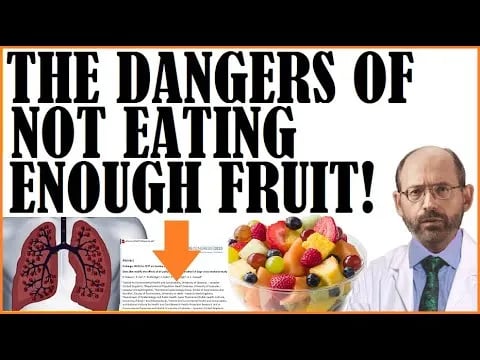
Here’s the wild part: in a rough-audio clip, Dr. Michael Greger points to the Global Burden of Disease (GBD) work and says that, in the United States, the number one killer wasn’t a virus or a rare condition—it was diet, with not eating enough fruit ranked as the top dietary risk. He even reacts to how surprising it feels: that fruit consumption could rank above smoking in that list of preventable risks.
“In the United States, the number one killer is not eating enough fruit… Number one killer… Eat fruit.”
The GBD project he’s referencing is massive: nearly 500 researchers, from 300+ institutions across 50 countries, starting with almost 100,000 data sources. That scale matters because it’s not a niche claim—it’s a big-picture look at what harms the global population, and what could be improved with simple habits like eating fruit rich foods more often.
Your imperfect, telling weekend experiment
Now for the human notes. You try a small experiment: four portions of fruit a day for one week. Nothing fancy—an apple, a banana, a cup of berries, an orange. You don’t change your commute, and you don’t pretend this is a clinical trial. You just pay attention during the busiest, most traffic-heavy parts of your day: do you feel less “tight” in your chest, less throat scratch, a little easier breathing when you climb stairs after being outside?
It’s imperfect, but it’s also the point: public health messages stick when they feel doable, not abstract. A clip like Greger’s makes the GBD findings memorable; your own notes make them personal.
A city-level “what if” for lungs and FEV1
One more wild card: imagine large cities treating high pollution alerts like heat alerts—by distributing fruit at transit hubs. If fruit consumption rises during the worst air days, could population-level lung function declines (like small FEV1 losses) be softened over time? No single snack replaces clean air, and no respiratory society would claim fruit is a shield. But as a low-cost, low-risk lever, “eat fruit” may be one of the simplest moves you can make—starting today.