

Nootropics & Biohacking – Evidence-based cognitive enhancement. starts with a simple truth: no pill reliably turns a healthy, rested person into a genius. Some tools can improve alertness, sustained attention, or specific memory tasks. Others may reduce stress that is interfering with clear thinking. But the biggest claims usually outrun the evidence.

I recommend treating cognitive enhancement as a decision process, not a shopping list. First identify the problem: poor vigilance during a long drive, difficulty learning material over weeks, stress-related distraction, or chronic sleep loss. Those are different problems, and they call for different solutions.
Table Of Contents
• What Cognitive Enhancement Can Actually Do
• How To Build An Evidence-Based Biohacking Plan
• Safety, Regulation, And When To Stop
What Cognitive Enhancement Can Actually Do
Nootropics are substances used with the goal of improving cognitive function, such as attention, memory, learning, or executive function. Biohacking is broader: it includes self-directed changes to sleep, exercise, nutrition, light exposure, technology use, and supplements. Nootropics are one possible tool within biohacking, not the foundation of it.
Match The Tool To The Cognitive Domain
The useful question is not, “What is the best nootropic?” It is, “Which outcome am I trying to change, and how quickly should a credible effect appear?” Cognitive performance is not one single trait.
| Goal | What It Means In Real Life | More Plausible Strategy | What It Does Not Prove |
|---|---|---|---|
| Alertness and vigilance | Staying attentive through a repetitive task | Caffeine, sleep recovery, strategic breaks | Higher intelligence or better learning |
| Executive function | Resisting distractions, planning, switching tasks | Adequate sleep, caffeine for some people, treating underlying conditions | Reliable creativity or judgment gains |
| Learning and memory | Retaining information over days or weeks | Structured practice, sleep, possibly longer-term supplements with evidence | Instant recall after one dose |
| Stress-linked focus | Thinking clearly when worry is consuming attention | Stress management, therapy when needed, some adaptogen research | A direct boost to every cognitive skill |
A human systematic review covering 256 papers published from 2000 through 2021 found that effects varied by compound and outcome. Its findings were notably domain-specific: caffeine was linked to attention and executive functions, bacopa to language, learning, and memory, ginkgo to perceptual and motor functions, and ashwagandha to anxiety and social-related cognition. Read the systematic review of plant-derived nootropics and human cognition as a corrective to the idea of a universal “brain boost.”
That distinction matters. A person who feels more awake after caffeine may complete email faster, yet still learn poorly if sleep debt is severe. Another person may feel calmer after a stress-focused intervention but show no meaningful change on a working-memory task. Subjective clarity and measured cognitive performance are related, but they are not identical.
Acute Enhancers And Slow-Building Options
Time to effect is one of the best filters for marketing claims. Acute enhancers should show their main effect within hours. Longer-term options, if they work, should be judged over weeks rather than one afternoon.
| Category | Expected Time To Effect | Typical Use Case | Main Interpretation Rule |
|---|---|---|---|
| Acute stimulant | Hours | Temporary fatigue, sustained attention, jet lag recovery | Compare against placebo, sleep, and caffeine tolerance |
| Prescription wakefulness agent | Hours | Clinical indications under medical care | Do not treat laboratory effects as routine healthy-user benefits |
| Long-term botanical | Weeks or longer | Memory or stress-related goals | Look for gradual, repeatable changes, not a first-day feeling |
| Lifestyle intervention | Days to months | Broad cognitive performance and resilience | Track adherence before judging failure |
Caffeine remains the most practical acute option for many adults because its alertness effects are familiar and relatively predictable. Its mechanism involves blocking adenosine receptors, which reduces the brain’s sleep-pressure signal. That can sharpen vigilance, but it does not erase the biological need for sleep. As the dose rises, so can jitteriness, anxiety, heart palpitations, and later sleep disruption.
L-theanine is often paired with caffeine because some people report a smoother subjective experience. Evidence for the combination is promising but less decisive than caffeine’s evidence alone, and product quality varies. I would not assume a “clean focus” label means the blend will outperform a simple, known caffeine routine.
Bacopa is different. It is usually discussed as a longer-term supplement for learning and memory rather than an acute performance enhancer. The practical implication is simple: if a product promises instant bacopa-driven recall, the claim should face a high level of skepticism.
Why Baseline Matters More Than Most Labels Admit
People starting with lower performance often have more room to improve. Sleep deprivation, unfamiliar tasks, high stress, and low baseline alertness can all make an intervention look more powerful. In contrast, a well-rested person already performing near their usual ceiling may see little measurable change.
The American Medical Association’s Council on Science and Public Health reported that prescription stimulants and modafinil can produce modest short-term improvements on some laboratory measures, with clearer benefits among people with lower baseline performance. Its review of stimulant and modafinil cognitive effects is important because it places a limit on the hype: a measurable task advantage is not the same as a broad upgrade in intelligence, wisdom, or career performance.
Consider two people using the same stimulant before an exam. One slept four hours and feels impaired. The other slept eight hours and has studied consistently. The first may notice a larger effect on staying awake. The second may notice little beyond extra stimulation. Neither result proves the drug improves long-term understanding.
How To Build An Evidence-Based Biohacking Plan
A good protocol reduces noise before it adds compounds. If caffeine intake, bedtime, workload, and supplement formulas all change at once, it becomes nearly impossible to tell what helped.
Start With The High-Return Foundations
Before testing a nootropic, I recommend checking the basic constraints on cognition:
- Sleep opportunity and regularity: Short sleep impairs attention, mood, reaction time, and learning. A stimulant may cover fatigue while making the following night worse.
- Movement and meals: Regular physical activity and adequate nutrition support energy regulation. Skipping meals, underfueling, or heavy alcohol use can look like an attention problem.
- Task design: A phone within reach, constant notifications, and vague priorities can defeat a supplement’s modest effect.
- Stress and health conditions: Anxiety, depression, ADHD, thyroid disease, anemia, sleep apnea, medication side effects, and substance use can all affect cognition. A nootropic is not a substitute for assessment or treatment.
This is not a moral argument against supplements. It is a measurement argument. When the foundation is unstable, the supplement signal is too easy to misread.
Use Evidence Tiers, Not Marketing Categories
“Natural,” “clinically studied,” and “proprietary blend” are not evidence tiers. I use a tougher standard: Does the ingredient have controlled human research in a population like the intended user? Does the study measure the goal being claimed? Was the effect meaningful, repeatable, and tolerable?
| Evidence Tier | Practical Meaning | Examples Of What To Look For | Buying Decision |
|---|---|---|---|
| Stronger support for a narrow outcome | Several credible human findings for a specific domain | Caffeine for alertness and sustained attention | Consider if risks and timing fit |
| Preliminary or mixed support | Small studies, narrow samples, inconsistent outcomes | Some botanical and combination products | Test cautiously, if at all |
| Weak support | Mechanism claims, animal work, testimonials, vague labels | Many “brain booster” blends | Usually skip |
A 2022 trial found that an acute multi-ingredient nootropic improved cognitive performance versus placebo in young healthy adults and did not worsen heart rate or heart-rate variability in that sample. The acute multi-ingredient nootropic trial in healthy adults is useful but should not be stretched beyond its design. It does not establish that every blend works, identify which ingredient drove the effect, or prove long-term safety.
That is the central problem with stacks. If a formula contains caffeine, amino acids, vitamins, botanicals, and stimulants, a positive result may be caused by one familiar ingredient, the combination, expectation, or an unmeasured change in sleep. The more ingredients added, the less clear the attribution.
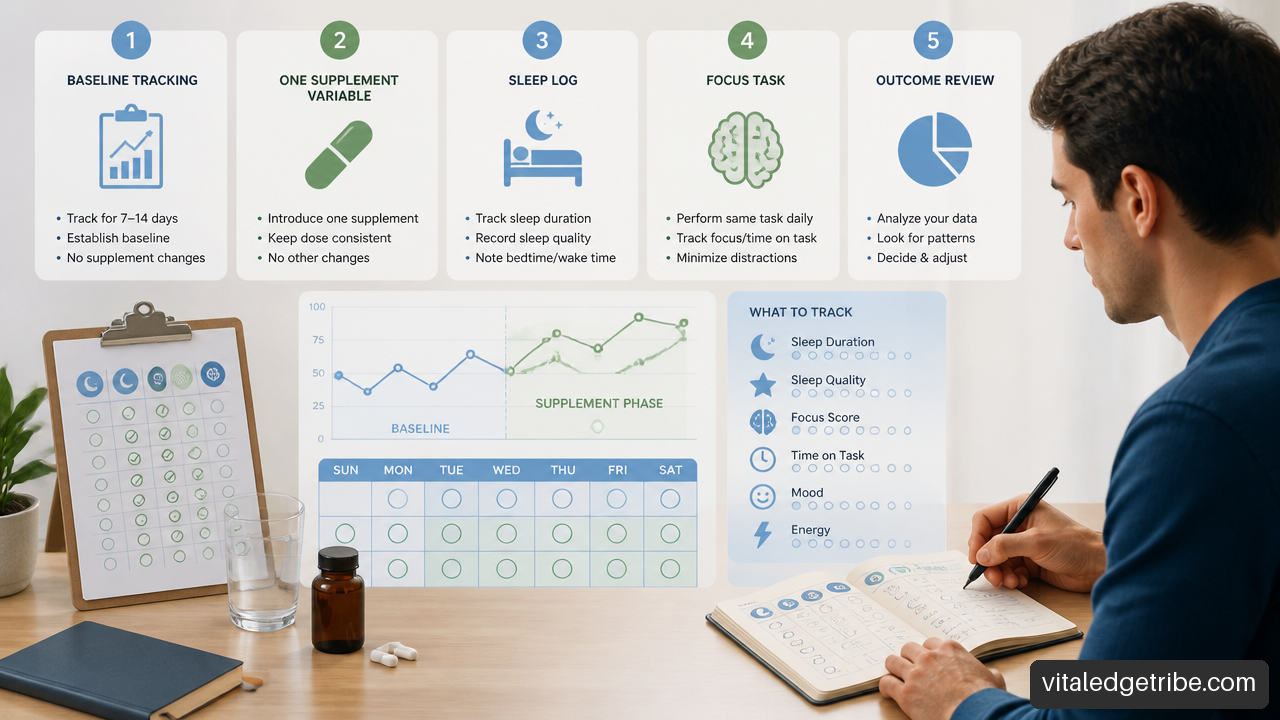
Run A Simple Self-Experiment
For healthy adults who decide to test an over-the-counter product, a structured approach is safer and more informative than chasing daily feelings.
- Choose one outcome. For example, use a five-minute reaction-time task, a fixed reading-comprehension quiz, or the number of focused work blocks completed.
- Establish a baseline. Record the same measure for at least several comparable days without changing other major habits.
- Change one variable. Use one product, one consistent timing pattern, and one stable brand and batch when possible.
- Record confounders. Track sleep duration, caffeine intake, alcohol, illness, unusual stress, and exercise. These can easily overwhelm a small effect.
- Use comparison days. If feasible, have a trusted person randomize identical-looking doses or use planned on and off days. Blinding is the best defense against expectation effects.
- Set a stop rule first. Stop for worsening anxiety, insomnia, palpitations, headaches, gastrointestinal symptoms, mood changes, or any concerning reaction.
A common failure mode is confusing reduced caffeine withdrawal with a new nootropic effect. Another is testing during an unusually exhausting week, then assuming the product works because it feels stronger under fatigue. Objective tracking will not make a weak intervention powerful, but it can prevent a costly false positive.
Safety, Regulation, And When To Stop
Safety is not determined by whether a product is sold online, labeled natural, or popular in productivity communities. Risk depends on the compound, dose, other drugs, health history, and timing.
Supplements And Prescription Drugs Are Different Categories
Prescription stimulants such as methylphenidate and wakefulness-promoting drugs such as modafinil have clinical uses, professional oversight, and a different regulatory status from dietary supplements. They should not be treated as stronger versions of coffee.
The evidence base also differs. A review in the PMC overview of nootropics as cognitive enhancers notes that many agents do not have immediate effects after a single dose, while healthy-adult efficacy and side-effect concerns remain uncertain. This is especially relevant for long-term, nonmedical use, where durability, tolerance, dependence, and real-world safety are not well established for many compounds.
Prescription status matters for another reason: using someone else’s medication or buying unregulated products marketed as prescription-like creates legal and medical risks. A drug that improves wakefulness can still impair sleep, raise anxiety, or encourage a cycle in which tomorrow’s fatigue is treated with more stimulation.
Who Should Be Especially Cautious
I would advise against casual nootropic experimentation without clinician input if any of the following apply:
• Pregnancy or breastfeeding
• A history of panic, bipolar disorder, psychosis, substance-use disorder, or severe insomnia
• Uncontrolled hypertension, heart rhythm concerns, or cardiovascular disease
• Use of prescription stimulants, antidepressants, sedatives, blood thinners, seizure medicines, or multiple supplements
• Persistent cognitive symptoms that are new, worsening, or affecting daily safety
The last point deserves emphasis. New confusion, memory loss, severe daytime sleepiness, headaches with neurological symptoms, or major mood changes should not be self-treated as a productivity issue.
The Long-Term Unknowns Are Part Of The Decision
Many enhancement claims focus on a few hours of testing. The harder questions are whether benefits last, whether tolerance develops, whether sleep quality declines, and whether users become dependent on a compound to feel normal. These outcomes are often under-studied in healthy adults.
A review hosted by the University of Hertfordshire concluded that smart-drug benefits in healthy brains are unclear or minimal at best, and that reported improvements may be temporary. The analysis of benefits and harms of smart drugs in healthy people supports a restrained approach: the possibility of a short-term edge does not automatically justify repeated use.
Fair warning: the safest cognitive enhancer is often not the most exciting one. A consistent sleep schedule, a morning light routine, regular movement, and fewer interruptions can improve the conditions under which attention works. They also carry a far lower risk of turning into an escalating stack.
Key Takeaways
What Is Most Likely To Help
• Use caffeine strategically for alertness and sustained attention, while protecting sleep and accounting for tolerance.
• Match the intervention to the domain. Bacopa is discussed more often for longer-term learning and memory outcomes; ashwagandha may be more relevant when stress is the limiting factor.
• Expect smaller gains in well-rested, high-performing people and larger apparent effects during fatigue or lower baseline performance.
• Build cognition from basics first. Sleep, physical activity, nutrition, stress management, and task design are the highest-value parts of cognitive biohacking.
What Deserves Skepticism
• Avoid claims of instant, universal intelligence gains. Vigilance is easier to improve than deep learning, judgment, or IQ.
• Treat proprietary blends carefully. A positive study of one formula does not validate every formula or identify the active ingredient.
• Do not use prescription drugs as lifestyle supplements. Their risks, legal status, and monitoring requirements are different.
• Stop when the cost exceeds the benefit. Anxiety, poor sleep, palpitations, and reliance are not acceptable trade-offs for a modest focus effect.
Frequently Asked Questions
What Nootropics Actually Work For Focus?
Caffeine has the clearest support for acute alertness, vigilance, and some executive-function tasks. Effects vary with tolerance, sleep, anxiety, and dose. For focus disrupted mainly by stress, poor sleep, or constant interruptions, fixing the cause may outperform adding another stimulant.
Which Nootropics Have The Best Evidence For Memory?
Bacopa monnieri has human research connected to learning and memory, but it is not an immediate memory enhancer. It is generally evaluated over sustained use. The quality of commercial products and the match between product formulation and study formulation remain practical limits.
Are Nootropics Safe For Healthy Adults?
Some are likely lower risk than others, but “safe” is not a blanket category. Caffeine can worsen anxiety and sleep. Botanicals can interact with medications. Prescription drugs carry additional risks and require medical oversight. Long-term safety evidence for many healthy-adult uses is limited.
Is Caffeine Still The Best Cognitive Enhancer?
For an accessible acute effect on alertness, caffeine is one of the strongest evidence-backed options. It is not automatically the best choice for everyone. If it causes insomnia, tremor, panic symptoms, or afternoon crashes, its real-world cognitive value may be negative.
Does L-Theanine Make Caffeine Work Better?
The combination may help some people feel less jittery than caffeine alone, but individual response varies. It should be tested as a specific combination, not assumed to be superior because it is common in nootropic products.
What Helps Most With Sleep Deprivation?
The best intervention is sleep. Caffeine and some prescription wakefulness agents may temporarily improve vigilance, but they do not fully restore learning, decision-making, or recovery. Using stimulants late in the day can also extend the problem by delaying the next night’s sleep.
Can Nootropics Improve IQ Or Only Performance?
Current evidence supports narrow, task-dependent effects more than lasting IQ improvement. A substance may improve speed or sustained attention on a test without changing broad intellectual ability. Better performance under fatigue is especially easy to mistake for a permanent cognitive upgrade.
How Can I Test A Nootropic Objectively?
Use one product at a time, select one repeatable task, track sleep and caffeine, compare planned on and off days, and use blinded testing when possible. Judge the result over enough comparable days to separate a genuine pattern from novelty, placebo, or a single unusually productive morning.
Sources And References
Research Reviews And Reports
PubMed — Plant-derived nootropics and human cognition: A systematic review
https://pubmed.ncbi.nlm.nih.gov/34978226/
PMC — Nootropics as Cognitive Enhancers: Types, Dosage and Side Effects
https://pmc.ncbi.nlm.nih.gov/articles/PMC9415189/
AMA — Report 9 of the Council on Science and Public Health (A-16)
https://www.ama-assn.org/sites/ama-assn.org/files/corp/media-browser/public/about-ama/councils/Council%20Reports/council-on-science-public-health/a16-csaph9.pdf
Clinical Study And Safety Analysis
Frontiers in Nutrition — Acute Effect of a Dietary Multi-Ingredient Nootropic as …
https://www.frontiersin.org/journals/nutrition/articles/10.3389/fnut.2022.858910/full
University of Hertfordshire Repository — Benefits and Harms of Smart Drugs (Nootropics) in Healthy …
https://uhra.herts.ac.uk/id/eprint/9633/1/Cognitive_enhancers_for_DRUGS.pdf